

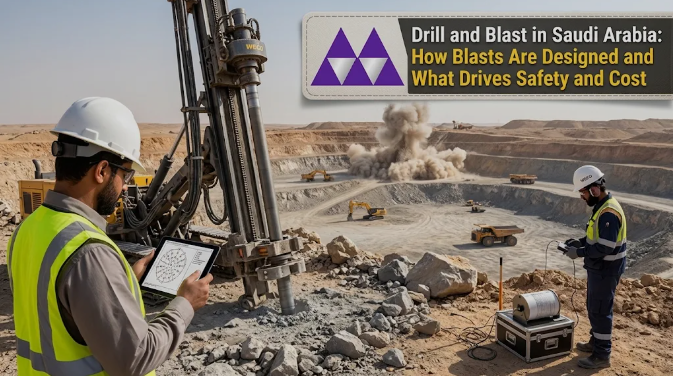
Quick answer: Drill and blast in Saudi Arabia means drilling a designed pattern of holes in rock and breaking it with explosives under a Ministry of Interior permit. The result depends on the rock mass, the blast design and how well the site measures vibration, flyrock and fragmentation. Before you hire anyone, check who holds the permits, who signs off on design changes and which costs sit outside the quoted rate. WECO, a mining and earthwork services provider based in Riyadh, offers these services in Saudi Arabia.
Last updated 10 November 2026
Controlled breakage of rock for excavation by using drilled holes and explosives is known as drill and blast. This guide is intended for the use of mine operators, quarry owners, engineering procurement and construction (EPC) contractors and procurement managers who are considering the use of drill and blast in Saudi Arabia. The first step is to establish the desired outcome at the bench and the desired outcome at the crusher.
What drill and blast covers, step by step?
Open-pit bench blasting begins with a blastability design for the ground and concludes with a review of the actual blastability result. Inquire from bidders who the owner of each handover is and what records will be provided.
- Design the blast based on the survey data, geology and production targets.
- Drill the approved pattern and record deviations.
- Confirm readiness by having a team of authorized personnel check with the approved plan.
- Obtain permits, establish exclusion area and arrange site access.
- Have the authorized shotfirer conduct the blast and control re-entry.
- Check for fragmentation, vibration readings and face condition.
Blast design inputs that decide the result
Fragmentation depends on the rock mass and how closely field conditions match the design. Hard rock in parts of the Arabian Shield can behave differently across a bench when joints, weathering or rock type change. Saudi geology overview
| Input | What it controls | What goes wrong |
| Rock mass | How rock breaks along joints and changes in material | Oversize blocks or uneven breakage |
| Bench height | Excavation geometry and drilling requirements | Uneven floor or difficult loading |
| Hole diameter | Drill selection and design flexibility | A pattern that poorly fits the bench |
| Burden and spacing | The rock volume assigned to each hole | Uneven breakage or excessive movement |
| Powder factor | Explosive quantity relative to rock volume or mass | A misleading benchmark when geology changes |
| Initiation timing | The sequence in which parts of the bench move | Poor movement or higher vibration |
Controlling vibration, flyrock and overbreak
Blast vibration and PPV monitoring
Blast vibration control combines engineering review with field measurements. A seismograph records ground vibration, including peak particle velocity (PPV), the maximum speed of ground particle movement during the event. Vibration and flyrock overview
Flyrock, stemming, overbreak and pre-splitting
Compare readings with the limits applicable to the site and nearby structures. Review stemming, the material that confines energy at the hole collar, and drilling deviations when assessing flyrock risk. Overbreak is rock removed beyond the intended boundary. Where appropriate, drill and blast engineers may specify pre-splitting to help protect the final wall. Project blasting procedure
Safety and compliance on Saudi sites
Explosives permits from the Ministry of Interior
Explosives permits are issued by Saudi Arabia’s Ministry of Interior. To manufacture, possess or dispose of explosives or to use, transport or store explosives the Law of Explosives and Fireworks licenses are required from the Ministry. Saudi law, articles 1 and 4 · Qanoniah text
Project authorizations, storage and mining approvals
The blasting procedure of the government project requires an authorization from the Ministry of Interior and all other permits as per the Saudi legislation. Inspect storage of explosives against recommended storage requirements in high heat. Separate mining approvals from explosives permits from the Ministry of Industry and Mineral Resources. Project procedure · Mining Investment Law
What drives drill and blast cost
Calculate the cost of the crusher per tonne of judge. If undersized rock is to be broken again or if the feed line to the crushers is to be broken by undersized rock, the lower the blasting service cost, the less competitive it is. Make price comparisons on a like-for-like basis. Consider delays due to drilling, mobilization and hauling to the crusher. If at a remote site, inquire about standby and resupply costs. Determine the way tonnes and crusher interruptions will be calculated.
Drill and blast contractors, consultants and engineers: who does what and how to choose
Who does what on a blast project
Drilling and blasting contractors execute the work. Drill and blast consultants can review designs or diagnose recurring problems. Engineers develop and assess the design, while drill and blast specialists may handle tasks such as monitoring.
Questions to ask when comparing rock blasting companies
When comparing rock blasting companies, ask:
- Who holds the relevant permits?
- Who signs off on design changes?
- How will you measure fragmentation?
- What monitoring records will we receive?
- Which costs sit outside the quoted rate?
WECO lists blast planning, rock drilling and controlled blasting among its services. WECO services
FAQ
Start with the rock, nearby structures and crusher requirements. These factors help define the result to specify, the records to request and the questions to put to bidders.
What is drill and blast in mining?
It breaks rock so loading equipment can excavate it. The team plans the blast for the bench geometry, ground conditions and intended size of the broken rock.
What affects blast fragmentation?
Rock strength and joints affect breakage. Bench geometry, drilling accuracy and how well the approved design matches the actual ground also influence the size distribution.
How is blast vibration controlled?
Engineers assess nearby structures, review the design and use a seismograph to check ground vibration. They compare the readings with applicable limits and review unexpected results.
How do you choose a drill and blast company?
Verify permits and experience in similar ground. Ask for sample monitoring records and clarify who handles design changes, oversized rock and delays under the contract.