

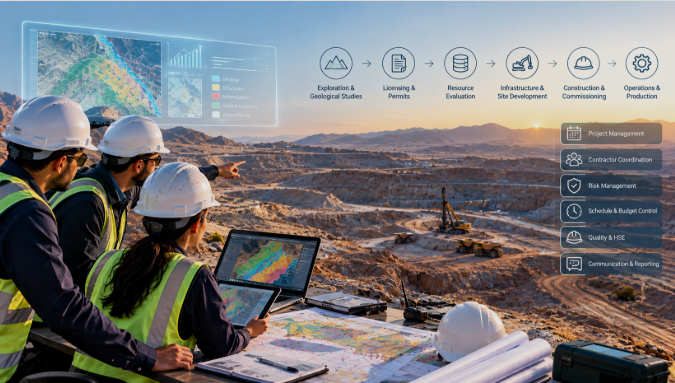
Mining projects rarely depend on one contractor, one technical discipline, or one stage of work. From early geological investigation to site preparation, drilling, infrastructure, procurement, and eventual operations, multiple teams need to work towards the same objectives while managing different schedules, resources, technical requirements, and commercial priorities.
When these activities are not properly coordinated, problems can quickly develop. Contractors may work to different schedules, equipment can arrive before a site is ready, procurement delays can affect field activities, and communication gaps can lead to duplicated work or missed responsibilities. Effective project management for Saudi mining provides the structure needed to bring these moving parts together and keep project development organized, measurable, and focused on delivery.
What Is Project Management for Saudi Mining?
Mining project management is the process of planning, coordinating, monitoring, and controlling the different activities required to move a mining project forward. It connects technical teams, contractors, suppliers, project owners, schedules, budgets, site activities, and project deliverables within one coordinated framework.
Rather than treating exploration, drilling, infrastructure, procurement, and operations as isolated services, effective mining project management considers how each activity affects the others. A delay in one workstream, for example, may affect contractor mobilization, equipment availability, field access, or the start of the next project stage.
Key Stages of a Mining Project
Mining projects can move through several development stages, although the exact sequence will depend on the mineral resource, project scale, location, regulatory requirements, and development strategy.
Early activities may include licensing, initial mining project planning, geological studies, and exploration programs. As more information becomes available, project owners may progress towards resource evaluation, technical assessments, feasibility planning, and decisions about further development. A greenfield mining project may also require significant preparation before major field activities can begin. Site access, mobilization areas, utilities, logistics, temporary facilities, and other requirements may need to be coordinated with exploration and development schedules.
Exploration drilling can then provide additional geological information needed for resource definition and project evaluation. If the project progresses, attention may gradually shift towards construction, infrastructure, mine development, production preparation, and operational activities. Strong Saudi mining project development requires project managers to understand how these stages connect, even when specialist contractors are responsible for carrying out the individual activities.
Coordinating Contractors and Technical Teams
One of the main challenges in mining is managing the number of specialist organizations involved in a single project. Geologists may be conducting mapping and interpreting exploration data while drilling teams prepare field programs. Earthworks’ contractors may be developing access or preparing working areas, while infrastructure contractors, equipment suppliers, logistics providers, and HSE or QHSE personnel manage their own responsibilities. Project management helps connect these teams by establishing responsibilities, reporting lines, schedules, milestones, and communication procedures.
This coordination is particularly important when working with multiple mining contractors Saudi Arabia projects may require. Contractors should understand not only their own scope but also how their work interacts with other activities. For example, drilling equipment cannot be efficiently mobilized if site access is incomplete. Similarly, suppliers need reliable schedules so equipment and materials arrive when they are actually required. Effective coordination helps reduce idle time, unnecessary mobilization costs, conflicting activities, and delays between project stages.
Choosing the Right Mining Contractor for a Saudi Project
Contractor selection can have a major influence on project execution. When assessing a Mining contractor for Vision 2030-related mineral-development projects, owners should look beyond the ability to perform one technical task. Relevant technical capability is important, but project owners should also assess previous mining and project experience, available equipment, workforce capacity, HSE performance, quality-management procedures, and the contractor’s ability to work within wider project schedules.
Strong project coordination is another important factor. A capable mining contractor Saudi Arabia project owners select should be able to communicate progress clearly, identify constraints early, coordinate with other contractors, and respond effectively when project conditions change. The right contractor should therefore contribute to the overall execution strategy rather than operate as an isolated service provider.
Where Exploration Drilling Fits into Project Management
Exploration drilling is an important part of many mineral exploration and development programs, but it must be considered within the wider project lifecycle. When engaging an Exploration drilling contractor Saudi project owners need to coordinate drilling schedules with geological objectives, site access, mobilization requirements, water and fuel availability, equipment logistics, HSE controls, sampling procedures, and laboratory or technical workflows.
Drilling may also depend on work completed by other teams. Geological targets must be defined, drilling locations prepared, access routes confirmed, and supporting resources organized before field activities can proceed efficiently. This is where project management adds value. Instead of managing drilling separately, the activity is integrated into the broader exploration program and connected to the technical information and project decisions that follow.
Integrating Infrastructure, Operations, and Project Delivery
As mining projects develop, coordination can become even more complex. Roads, utilities, facilities, equipment, logistics, contractors, and operational teams may all need to be aligned with project priorities.
Saudi mining infrastructure development consulting can support decisions around development requirements, while mining operations and production consulting can help project owners prepare for the transition towards operational activities. Project management connects these specialist inputs so that decisions are made within the context of the complete project.
This integrated approach also improves visibility. Owners and investors can better understand what has been completed, what remains outstanding, which activities are affecting the schedule, and where management attention is required.
Building More Coordinated Mining Projects in Saudi Arabia
Successful mining development depends on more than technical expertise alone. It requires geological teams, contractors, suppliers, project managers, HSE personnel, infrastructure specialists, and operational teams to work within a coordinated delivery structure. Effective project management for Saudi mining helps establish that structure. By connecting planning, people, resources, contractors, schedules, and technical activities, project owners can reduce avoidable disruption and maintain greater control as projects move from exploration towards development and operations. For mining businesses and investors entering or expanding within Saudi Arabia, strong project coordination can provide the foundation needed to manage complex projects efficiently and turn individual technical activities into a connected project-development program.
FAQs
What does project management for Saudi mining projects involve?
It connects every workstream exploration, drilling, infrastructure, procurement, and operations under one coordinated framework. Project management for Saudi mining projects establishes responsibilities, schedules, milestones, and reporting lines so contractors and technical teams work toward the same objectives. WECO delivers this coordination for mining projects across Saudi Arabia, ensuring each activity supports the next stage of development.
How do mining contractors coordinate on Saudi mining projects?
Mining contractors in Saudi Arabia need to understand not only their own scope but how their work interacts with other activities. Drilling equipment cannot mobilize efficiently if site access is incomplete. Suppliers need reliable schedules so materials arrive when required. Project management connects contractors by defining reporting lines, schedules, and communication procedures reducing idle time, unnecessary mobilization costs, and delays between stages.
How does exploration drilling fit into project management?
Exploration drilling must be integrated into the wider project lifecycle, not managed in isolation. A project management approach coordinates drilling schedules with geological objectives, site access, mobilization requirements, water and fuel availability, equipment logistics, and sampling procedures. This ensures drilling activities connect directly to the technical information and project decisions that follow.
What is Saudi mining infrastructure development consulting?
It supports decisions around site access, utilities, facilities, logistics, and equipment alignment with project priorities. Infrastructure development consulting in Saudi Arabia ensures that roads, working areas, and support facilities are planned in coordination with exploration and development schedules not treated as separate activities. This prevents conflicts between earthworks, drilling, and procurement timelines.
What is mining operations and production consulting?
It helps project owners prepare for the transition from development to operational activities. Mining operations and production consulting in Saudi Arabia supports decisions about production readiness, equipment selection, workforce planning, and the handover from project teams to operational teams. It connects specialist inputs so decisions are made within the context of the complete project not in isolation.