

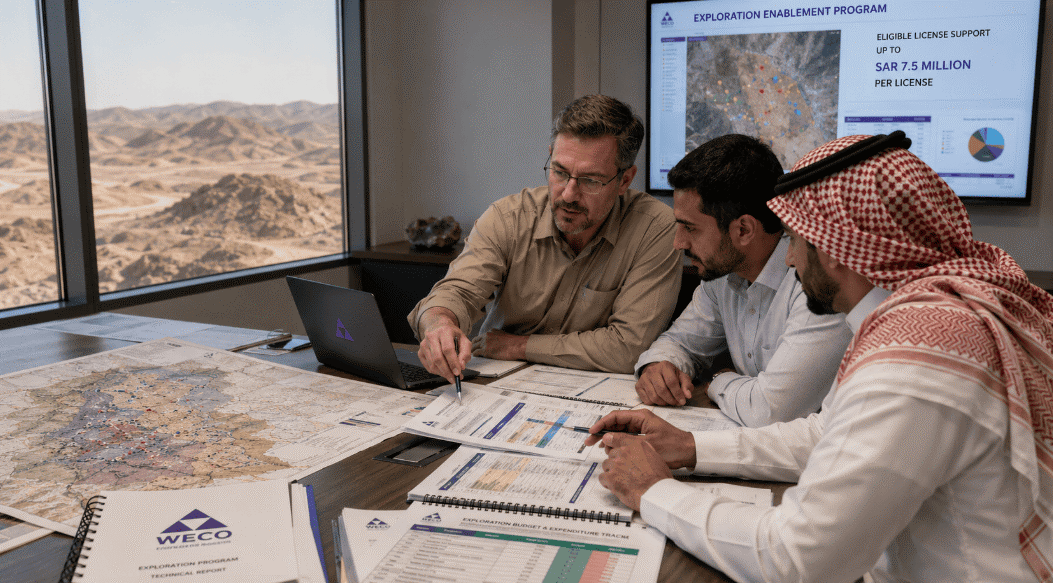
The Exploration Enablement Program in Saudi Arabia pays up to SAR 7.5 million per license to cover up to 100% of early-stage exploration costs, for geophysical surveys, geochemical sampling, drilling and geological mapping submitted on the Taadeen platform. Licenses with a term of ≤ 5 years are eligible. WECO organizes and develops Mining exploration services KSA programs throughout the Arabian Shield to ensure they meet the requirements of the Ministry’s audit, maximize reimbursements and avoid documentation errors that lead to lost reimbursements.
What is the Saudi Arabia Exploration Enablement Program and who is eligible?
The Exploration Enablement Program is the name given to the incentive, which is a sovereign program of the MIMR and that reimburses qualified companies up to SAR 7.5 million per exploration license in existence and not yet five years old. The SAR 685 million allocation is for early geology by Saudi and 100%-foreign owned operators to minimize subsurface risk. Mining exploration services KSA funding advances Vision 2030 mining investment KSA as public mapping alone cannot prove the presence of all the minerals found within the SAR 9.4 trillion estimated endowment of Saudi Arabia.
Which exploration licenses qualify for the SAR 7.5 million EEP reimbursement?
Active licenses with five-year limits that have passed qualified spend thresholds and completed work within the boundaries set by Taadeen within a Wave window are eligible for the licenses. Wave 1, Wave 2 and active Wave 3 have set deadlines and non-compliant licenses are not eligible to stand until they become so. Each mineral deposit in Saudi Arabia license is evaluated separately and the three licenses could have a total value of SAR 22.5 million.
What exploration costs are reimbursable under the Saudi EEP?
Saudi Arabia claims to offer reimbursement for airborne electromagnetic and ground-magnetic and induced-polarization surveys and EEP also reimburses geochemical sampling, geological mapping, accredited assays, diamond-core or RC drilling, remote mobilization, downhole logging, core logging, and sample preparation. The chain-of-custody, permits, methods, and certificates can be exported to internationally accredited lab and can be checked in MIMR (not necessarily in Riyadh processing). Not all management overhead, office, travel, reports, legal and environmental compliance costs are included.
How must geophysical surveys be designed to meet MIMR auditing standards?
All geophysical survey Saudi Arabia programs must be conducted by a registered provider and be within the Taadeen’s licensed area of operations, and must provide all data in SGS accepted projections, GIS shapefile, attribute and structural-measurement formats, and report in an SGS acceptable format for ingestion to the National Geological Database. WECO specifies these deliverables at contracting. If this is not the case, an SAR 800,000 claim for airborne-EM may be refused even if it has been fielded properly, due to the inability to check coordinate systems or shapefile fields.
Step-by-step: How to structure and submit an EEP reimbursement claim
A successful claim follows six controlled stages:
- Structure the budget: Separate overhead and fieldwork; match the lines of your invoice to the MIMR categories.
- Engage registered contractors: Check current MIMR registration; unregistered-contractor invoices are rejected, no matter how good.
- Control technical formats: Keep maps, logs, assay databases, coordinates and metadata within SGS standards while executing.
- Compile evidence: Correlate completed work-program milestones to paid invoices, bank transfers, completion certificates, and deliverables.
- Submit through Taadeen: The entire package is to be uploaded prior to the Wave closing date; late claims will not be accepted.
- Manage audit queries: Typically, auditors respond within 30-45 days and delayed responses may be way past the claims. WECO is responsible for bilingual query responses and reconciliations.
How does Wave 3 of the EEP affect exploration program timelines in 2026?
For the Wave 3 (mid-2026) phase of licensing, the budget structure and submission process for Q1–Q2 will be critical, as the licenses will start work after the Wave 2 cutoff. Data collected from drilling, sampling, and geophysical work should be collected in the field during Q4 and during Q1 prior to extreme summer heat. Wave 2 saw more than 3,000 sq km of active exploration. When it comes to Saudi Arabia submissions, WECO coordinates field milestones to Wave 3 evidence requirements. Wave 4 is yet to be confirmed, however, the mining investment KSA targets for Wave 4 and the objective continuation program for the SAR 240 billion mining GDP supports the continuation of the mining investment in Wave 4.
Why do EEP reimbursement claims fail and how does WECO prevent claim rejection?
The problems with a claim typically have nothing to do with the costs being ineligible; it is more likely to be because the invoice doesn’t include all the costs or because the geological data is not in an SGS format or because the contractor’s registration has expired. A junior drilling and EM team drilled 10,000 metres of RC and airborne EM over a concession area of 500 square kilometers in the Central Province for SAR 5.8 million.
The Saudi Exploration Enablement Program offers compensation of up to SAR 7.5 million for each exploration license to qualified exploration work. The vast majority of companies that are losing reimbursement don’t have an eligibility issue. Their documentation is an issue. Invoices are improperly formatted. The geological data has an incorrect format. The contractor registration process is still not controlled at the time of contract signing. Saudi Arabia has set aside SAR 685 million, as the private sector has to demonstrate its SAR 9.4 trillion mineral resources. Funding exists. It calls for an audit-ready framework from Day One.
FAQs:
Q1: What is Saudi Arabia’s Exploration Enablement Program?
Saudi Arabia’s Exploration Enablement Program is a government backed incentive designed to support eligible mineral exploration activities. Qualified exploration license holders may receive reimbursement for approved exploration costs, including geological mapping, geophysical surveys, geochemical sampling, drilling, and related technical work, subject to the program’s eligibility and documentation requirements.
Q2: How much funding can an eligible exploration license receive?
Eligible exploration licenses may qualify for up to SAR 7.5 million in reimbursement for approved exploration activities. The actual amount depends on the license, eligible expenditure, approved work program, program requirements, and supporting documentation submitted through the relevant process.
Q3: Which exploration activities may qualify for reimbursement?
Eligible exploration activities may include geological mapping, geophysical surveys, geochemical sampling, diamond core drilling, reverse circulation drilling, accredited laboratory assays, downhole logging, core logging, sample preparation, and certain approved mobilization costs. Eligibility depends on the specific program requirements and supporting evidence.
Q4: What types of exploration licenses may qualify for the EEP?
Active exploration licenses that meet the program’s eligibility conditions may qualify for reimbursement. License term, work completed, approved exploration activities, expenditure thresholds, submission windows, and compliance with the relevant licensing and documentation requirements can affect eligibility.
Q5: What documents are required for an Exploration Enablement Program reimbursement claim?
A reimbursement claim generally requires evidence of completed exploration work and eligible expenditure. This may include invoices, payment records, contractor documentation, work program evidence, geological data, maps, survey outputs, drilling records, assay results, completion certificates, and technical deliverables required for review and audit.
Q6: Why do exploration reimbursement claims fail in Saudi Arabia?
Claims may fail because of incomplete supporting evidence, incorrectly formatted invoices, ineligible expenditure, missing technical data, outdated contractor registration, inconsistent work program records, or failure to meet submission deadlines. Documentation and data quality should be controlled throughout the exploration program rather than prepared only when the claim is due.
Q7: How can exploration companies prepare for an EEP audit?
Companies should maintain an audit ready record of exploration activities from the beginning of the project. This includes matching invoices to approved work activities, retaining payment evidence, maintaining accurate geological and geophysical data, verifying contractor eligibility, and preserving technical deliverables in the required formats.
Q8: What does WECO provide for Saudi Arabia exploration funding programs?
WECO supports exploration companies with mining exploration services in Saudi Arabia, including exploration program planning, technical documentation, expenditure tracking, contractor coordination, data and deliverable management, reimbursement claim preparation, and responses to documentation or audit queries.