

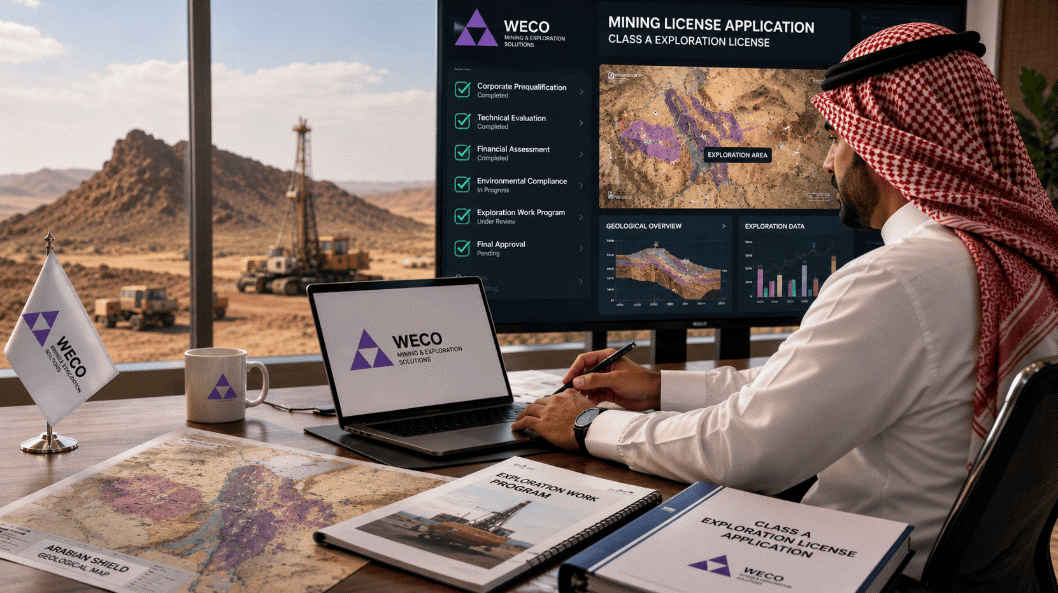
To secure a Class A exploration license in Saudi Arabia, they must be pre-qualified on the ‘Taadeen’ electronic platform (as per Cabinet Decision No. 634/1441), make an exploration commitment of at least SAR 3.9 million for the first 2 years, and pay a 15% performance bond on this exploration spend. WECO’s Saudi mining licensing consulting team in Riyadh is responsible for corporate prequalification, awarding of mining permits, and compliance reporting for companies that are legally exploring for mining in the Arabian Shield of Saudi Arabia.
What is the Taadeen platform, and how will the Saudi Arabia’s mining license applications be handled there?
Now, with MIMR handling it, Taadeen is Saudi Arabia’s compulsory digital platform for mining apps, eliminating manual submissions and processing of full files with automated review in just 30 days. On the Taadeen portal, the corporate registration number, technical skills, audited finance reports, and fields are validated for a MIMR exploration license application. The warning key Taadeen portal guide is the one that tells you that there are verified or incomplete files, which are rejected, not delayed.
What is the significance of Saudi Arabia’s Mining Investment Law in defining the types of mineral deposits and what is meant by Class A?
Think of proposal Cabinet Decision No. 634/1441, which suggests three categories of minerals: metallic minerals, industrial minerals, construction minerals; and different royalties, rights and obligations for different classes. Lead, nickel, cobalt, platinum group metals and associated ores are also included in class A. Applications must be filed if the class is misidentified. Saudi Arabia target is misclassified by foreign companies due to use; use determines royalties and bonds. Saudi Arabia’s mineral wealth is officially valued at an estimated SAR 9.4 trillion. The Mining Investment Law permits 100% foreign ownership of exploration operations. Vision 2030 targets a SAR 240 billion annual mining sector GDP contribution by 2030.
What kind of financial guarantees and performance bonds does MIMR need?
Up to a minimum of a 2-year exploration commitment of SAR 3.9 million, plus a performance bond of 15% of this expenditure is required before the exploration is technically reviewed at MIMR. Qualifying expenditure includes diamond-core and reverse-circulation drilling, geophysical surveys, geochemical sampling, geological mapping, downhole surveys and core logging. This excludes overheads such as office rent, report writing fees, travel etc., and project-management overhead is not included. If an underspending occurs prior to the end of term, then the license will be terminated and the entire bond will be forfeited with no appeal.
What are the prequalification requirements that exploration companies have to fulfill before putting forward for a Taadeen application?
Mining licensing consulting starts prior to submitting a Taadeen: applicants must hold an active MIMR corporate prequalification indicating the geological-team’s capability, audited finances, bank guarantees and standing through a Saudi subsidiary or Ministry of Investment license. Geological CVs must be prepared following MIMR template, even if they have a good CV in the international format. Management accounts will be rejected if not audited and foreign companies underestimate the time for registration of a subsidiary. Recurring failures are non-template CVs, unaudited accounts, and incomplete local-entity evidence.
What are the six steps required to submit a successful Class A application on the Taadeen platform?
1. Get MIMR Corporate Prequalification. Provide technical and financial qualifications. Wait 3-4 weeks after Taadeen automation.
2. Register Entity on Taadeen Portal. Use the prequalification number. All cross-references have to match otherwise they are rejected.
3. Find the Target Blocks available. Review registry. Sealed bids for tender blocks, direct applications for open blocks.
4. Draw up Technical Work Program. Make SAR 3.9 million commitments on eligible activities. WECO mapping rationalizes target geology to Arabian Shield.
5. Fill Out and Sign the documents and lodge them in the office. Funded 15% from a Saudi bank, registered in Saudi Arabia. Provide audited statements and parent company support.
6. Submit and handle Queries. File and monitor on a regular basis daily. Delayed responses delay assessment or to close the application window.
The December 2025 awards for the MIMR exploration license KSA program included 172 sites, 24 companies and SAR 671 million-plus for two-year exploration licenses.
What are the environmental requirements for the approval of exploration licenses at MIMR?
Pre-assessment of NCEC for application class A is mandatory and pre-assessment report must include pre-assessment of wadi discharge, mud-pit remediation, and vegetation-clearance limits before final technical review by MIMR. These are the top documents that come up in LinkedIn discussions involving Saudi mining professionals that delay entry. Competitor content leaves the driller to calculate reclamation-bond rates, whereas WECO makes the assessment, remediation plan, and bond calculation in two languages as part of its licensing support.
Comparison:
Application Element | Without Licensing Support | With WECO Licensing Team |
| Prequalification preparation | Trial and error — 2 to 4 months | Structured from day one — 3 to 4 weeks |
| Technical work program | Generic template — often rejected | Tailored to Arabian Shield target geology |
| Performance bond calculation | Often incorrectly structured | Precise 15% against qualifying spend |
| Environmental pre-assessment | Most common failure point | Prepared by WECO environmental team |
| MIMR query responses | Delayed — extends timeline | Responded within 48 hours — Arabic and English |
| Total time to permit award | 6 to 12 months for unprepared | 45 to 90 days for complete applications |
QUICK ANSWER:
Securing a Class An exploration license in Saudi Arabia through the Taadeen platform requires MIMR corporate prequalification, a minimum SAR 3.9 million committed exploration spend, and a 15% performance bond lodged with a Saudi-registered bank. Complete the application process in under 30 days. Incomplete applications are rejected without explanation. WECO’s licensing team in Riyadh manages the complete process from prequalification through permit award under Cabinet Decision No. 634/1441.
Why do Taadeen applications not succeed and how does WECO’s approach avoid any delays?
The majority of Class A failures are prequalification failures due to documents submitted in formats that are not technical or financial in order to be automatically rejected for human review. A Canadian-Saudi juniors targeting a copper-gold skarn in Western Province, submitted a full program with the right bonds, but did not get rejected for reasons and was rejected in automated within 48 hours. WECO’s failure was due to the CV which was prepared in an international format by the lead geologist, and subsequently restructured by WECO, prepared in Arabic and English by WECO, and prepared for re-submission by WECO. The license was granted by MIMR 67 days later. There was no further delay due to bilingual files, template compliance and Taadeen portal query management.
The Taadeen portal takes less than 30 days to process a fully-fledged application. If it is not filled in completely, then it is rejected without giving any explanation. Most rejections are not due to incorrect geology or to a low budget. They occur due to the documentation package not meeting MIMR’s technical and financial formatting requirements. In December 2025, Saudi Arabia alone paid SAR 671 million for exploration licenses. Those licenses were issued to companies that have prepared their applications correctly. WECO’s mining licensing consulting team in Riyadh takes care of the process. To discuss your application, contact WECO.
FAQs:
Q1: Can a foreign company hold 100% ownership of a Class A exploration license in Saudi Arabia?
Yes. Saudi Arabia’s Mining Investment Law explicitly permits 100% foreign ownership of exploration and production operations. Foreign companies must establish a registered Saudi subsidiary or obtain a Ministry of Investment license before submitting a Taadeen application but full equity ownership by the international entity is permitted under Vision 2030’s reformed mining investment framework.
Q2: What is the minimum financial commitment required for a Class A exploration license in Saudi Arabia?
The minimum committed exploration spend is SAR 3.9 million during the initial two-year license term. A 15% performance bond calculated against this committed expenditure must be lodged through a Saudi-registered bank before MIMR advances the application to technical review. Qualifying expenditure includes drilling, geophysical surveys, geochemical sampling, geological mapping, and core logging.
Q3: How long does the Taadeen platform take to process a complete mining license application?
A complete, correctly prepared application processes through Taadeen’s automated review in under 30 days. The critical word is complete incomplete applications are rejected without explanation, not delayed. Most rejections happen at prequalification because documentation does not match MIMR’s exact technical and financial formatting requirements, not because the geology or budget is insufficient.
Q4: What documents are required for MIMR corporate prequalification before a Taadeen submission?
MIMR prequalification requires geological team CVs formatted to MIMR’s specific template not international CV formats audited financial statements, bank guarantees demonstrating financial capacity, and proof of corporate standing through a registered Saudi subsidiary or Ministry of Investment license. Unaudited management accounts are automatically rejected. This prequalification stage takes 3 to 4 weeks and must be completed before Taadeen registration.
Q5:What is the difference between Class A, Class B, and Class C mineral deposits under Saudi mining law?
Class A covers metallic minerals including gold, copper, zinc, silver, nickel, and platinum group metals found in the Arabian Shield’s Precambrian basement. Class B covers industrial minerals. Class C covers construction materials including sand, gravel, and limestone. Each class carries different royalty rates, operational rights, and bond requirements. Misclassifying a target commodity at application stage requires a full reapplication there is no amendment mechanism.
Q6: What environmental compliance does MIMR require before approving a Class A exploration license?
Every Class A application must include an environmental pre-assessment form submitted to the National Center for Environmental Compliance covering wadi water discharge protocols, mud pit remediation plans, and vegetation clearance limits. This pre-assessment is the most common cause of application delays for companies entering Saudi Arabia without local support. Environmental reclamation bond rates for drilling operations must also be calculated and included.
Q7: What happens if a company fails to meet its committed exploration spend before the two-year license term expires?
Failure to meet the committed SAR 3.9 million exploration spend before the two-year term expires results in license termination and full forfeiture of the 15% performance bond with no appeal mechanism under current MIMR regulations. This is why structuring the exploration work program to generate qualifying expenditure across the full two-year period, not just in the final months, is essential from program inception.
Q8: Does WECO handle the complete Taadeen application process or only specific stages?
WECO’s Saudi mining licensing consulting team manages the entire process MIMR corporate prequalification, Taadeen portal registration, technical work program preparation, performance bond structuring, environmental pre-assessment preparation, application submission, and ongoing MIMR query management in Arabic and English. International companies working with WECO avoid the documentation failures that cause automated rejection at the prequalification stage.