

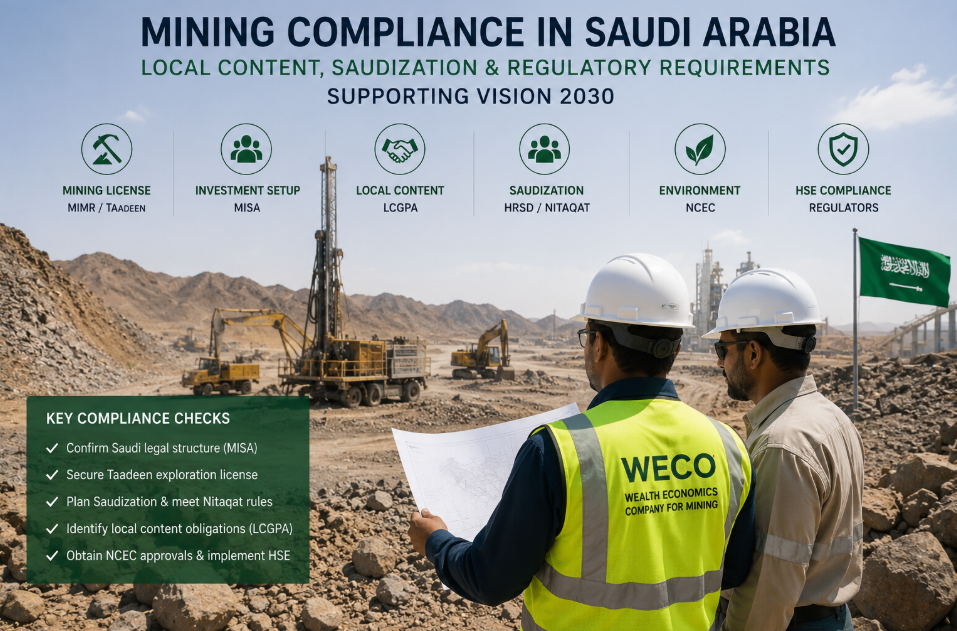
Foreign mining companies in Saudi Arabia need to consider local content, Saudization, mining licensing, and environmental compliance before project mobilization. LCGPA covers local content requirements, HRSD manages workforce localization through Nitaqat, while MIMR and Taadeen handle mining licensing. NCEC covers applicable environmental compliance. For foreign operators, WECO combines mining exploration, licensing support, and local project knowledge in Saudi Arabia
Local content, Saudization, and regulatory compliance are key elements in the successful delivery of mining projects in Saudi Arabia. International companies need to meet Saudi licensing, labor, environmental, and project-specific requirements while contributing to the economic goals of Vision 2030. Choosing a mining contractor for Vision 2030 therefore requires both technical capability and knowledge of local compliance requirements. One Saudi mining contractor operating in this environment is WECO.
Why Local Content and Saudization Matter for Mining Projects
Saudi Arabia is advancing the development of the mining sector as one of the most important areas under the Kingdom’s Vision 2030 economic development agenda. The sector’s expansion extends across the Kingdom’s mineral-rich regions, including the Arabian Shield. The national mining strategy aims to unlock mineral resources and increase domestic value creation.
For foreign investors, local content should be understood as more than simply purchasing Saudi materials. Project-related activities may include the use of Saudi suppliers, local services, workforce development, local procurement, and contractual commitments.
Local-content mechanisms are regulated by the Local Content and Government Procurement Authority (LCGPA), particularly in government, state-owned enterprise, PPP, and related public procurement contexts. Local-content requirements can vary significantly between projects and tenders, so contractors should review the specific tender and contractual requirements carefully.
Saudization is a separate requirement. It aims to increase the participation of Saudi nationals in the private-sector workforce in accordance with the classifications and requirements of the Nitaqat program. A new phase of the program began in 2026 and is expected to be implemented over three years.
Key Compliance Requirements for Mining Contractors
Foreign operators should map their compliance responsibilities before mobilization rather than waiting until crews and equipment have already reached the site.
| Area | Responsible authority/system | What project teams should check |
| Mining license | MIMR / Taadeen | License type, work program, technical capability and reporting |
| Investment setup | Ministry of Investment (MISA) | Investment registration and corporate structure |
| Local content | LCGPA | Tender-specific requirements, local suppliers and reporting |
| Saudization | HRSD / Nitaqat | Applicable workforce localization requirements |
| Environment | NCEC | Environmental permits, studies and ongoing compliance |
| HSE | Relevant regulators/client systems | Risk controls, competent workers and site procedures |
5-Point Compliance Checklist for Foreign Mining Companies
- Confirm the Saudi legal structure by completing the appropriate MISA investment registration and Saudi corporate requirements.
- Establish the licensing pathway by identifying the correct Taadeen license and preparing all supporting technical documentation.
- Integrate Saudization into workforce planning by ensuring that the organization meets the applicable Nitaqat requirements before recruitment begins.
- Identify local-content obligations, as these may differ between contracts. Review any LCGPA, government, SOE, or tender-specific commitments.
- Incorporate environmental and HSE requirements early by securing the relevant NCEC approvals and establishing field HSE controls before mobilization.
These checks should be carried out alongside the technical program for mining exploration services in KSA rather than being treated as an administrative activity after exploration planning has been completed.
Common Compliance Mistakes Foreign Companies Make
A frequent mistake is assuming that international “best practice” automatically satisfies Saudi requirements. It may not. Saudi-specific review is still required for corporate registration, licenses, employment status, environmental permits, and other contractual matters. Another common issue is treating Saudization as a recruitment problem to be addressed only after the contract has been awarded. A contractor may mobilize rigs and bring in specialist personnel only to discover that the proposed workforce structure is not aligned with applicable Nitaqat requirements.
Incomplete applications for exploration licenses can also cause significant delays. Under the Taadeen process, applicants are required to submit the necessary corporate, technical, financial, and work-program information well before planned mobilization. Local procurement can present another practical challenge. Procurement teams may identify an overseas supplier as the preferred option, while a government-linked tender may include specific local-content requirements or incentives that favor Saudi suppliers or locally sourced products and services.
Environmental controls, camp arrangements, transportation, competent site personnel, emergency plans, and HSE documentation are also essential for operating effectively in remote Arabian Shield locations. Site preparation and infrastructure planning are equally important, particularly for access roads, drill pads, water supply, remote camps, and other facilities required before field operations begin.
How WECO Supports Compliant Mining Projects
WECO provides both exploration execution services and local regulatory and technical support. Its services include geological exploration, drilling support, mapping, data validation, QHSE consultancy, and mining-licensing consultancy. WECO also provides licensing support, including documentation preparation, coordination with regulators, application submission, and compliance assistance for both local and international mining companies.
For foreign operators, this can help reduce coordination challenges between the geological program and Saudi administrative processes. However, as with any contractor, WECO should be independently assessed based on its technical capabilities, HSE performance, commercial terms, local-content strategy, Saudization planning, and reporting quality.
FAQs
What is Saudization in Saudi Arabia’s mining sector?
Saudization, implemented through the Nitaqat program, is a Saudi policy designed to increase the employment of Saudi nationals in private-sector organizations. Requirements vary according to economic activity, establishment type, and other classifications, so mining companies should confirm the specific HRSD requirements applicable to their operations rather than relying on a single general percentage.
What local content requirements apply to mining contractors?
Requirements depend on the project and contracting structure. LCGPA mechanisms are particularly relevant to government, SOE, and PPP procurement, while individual mining tenders and contracts may include additional localization requirements. Contractors should review bid documents for applicable percentages, certifications, reporting requirements, and mandatory local products or services.
Can foreign companies operate mining projects without a Saudi partner?
A Saudi equity partner is not always required. However, foreign investors must comply with the applicable MISA investment framework and activity-specific requirements. For an exploration license, the applicant generally needs to operate through a company registered in Saudi Arabia. Certain investment activities may also require additional approvals.
What approvals are required before starting a mining exploration project?
Requirements vary by project and may include an appropriate Taadeen exploration license through MIMR, Saudi corporate or investment registration where applicable, and relevant environmental authorizations through NCEC. Mobilization-related obligations concerning labor, Saudization, HSE, land access, and other operational requirements should also be confirmed at this stage.
How is local content measured for mining contractors in Saudi Arabia?
Local content can be measured through areas such as employee compensation, goods and services, capability development, and asset depreciation, depending on the applicable LCGPA framework. Mining contractors should also review the specific tender or contract because local content requirements can differ between projects. Keeping supplier records, workforce information, and supporting documents from the start makes later reporting much easier.
Do mining contractors need to use Saudi suppliers and local workers?
The requirement depends on the project, contract, and applicable local content and Saudization rules. Some mining programs can include commitments to use local service providers and develop Saudi capability. For example, the Taadeen Exploration Enablement Program specifically refers to local capability development and commitments to use local providers for services and contracts. Foreign operators should confirm the exact requirements before mobilization.
Conclusion
Compliance is as important as drilling, geology, and field productivity when delivering mining projects in Saudi Arabia. Foreign investors should plan for licensing, Saudization, local content, environmental compliance, HSE, and procurement requirements alongside the exploration program from the outset. Companies seeking a locally experienced mining contractor for Vision 2030 projects can contact WECO (Wealth Economics Company for Mining) for mining exploration, licensing support, and practical project-compliance guidance in Saudi Arabia.